Home / Our solutions / Ground-mounted and Floating Solar Power Plants
Ground-mounted and Floating Solar Power Plants
How does a ground-mounted or floating solar power plant work?
Large-scale technical structures, ground-mounted and floating solar power plants are solutions that enable the production of renewable electricity in large quantities, thus contributing to French and European green energy goals.
Ground-mounted solar power plant
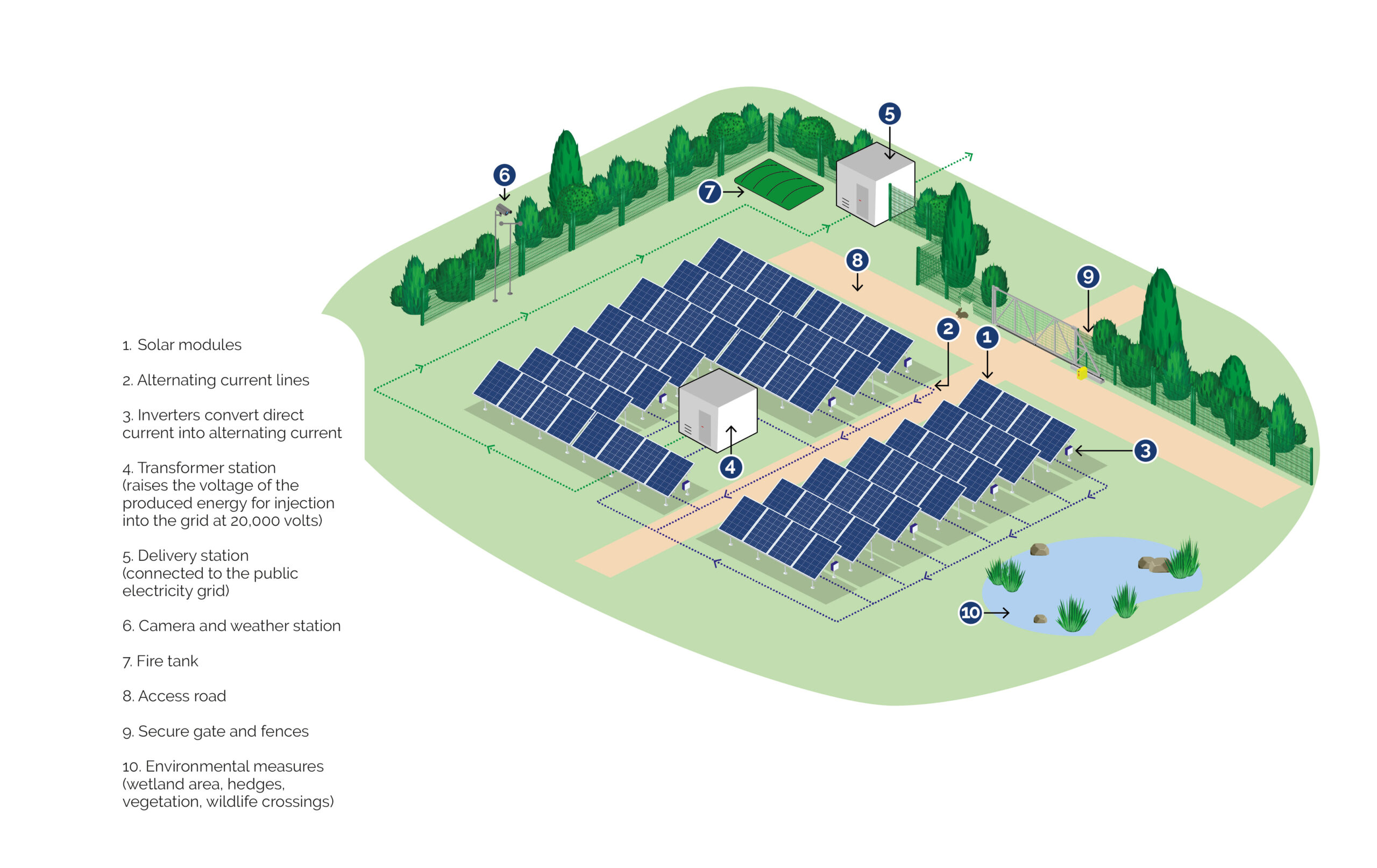
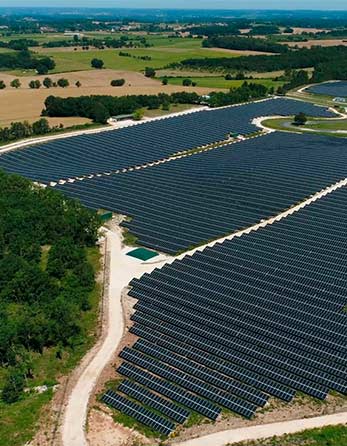
A ground-mounted photovoltaic power plant is composed of various elements:
- Photovoltaic modules, also known as solar panels.
- Mounting structures for the modules, which are anchored to the ground in various ways—most commonly on concrete beams (longrines) or driven piles.
- Connection cables that link the different module tables to the inverters, which are themselves connected to the transformer and then to the delivery station.
- Technical rooms housing inverters (which convert direct current into alternating current), transformers (which increase the voltage), and electrical protection equipment.
- Delivery station, for injecting the electricity produced by the ground-mounted solar plant into the electrical grid.
Floating solar power plant
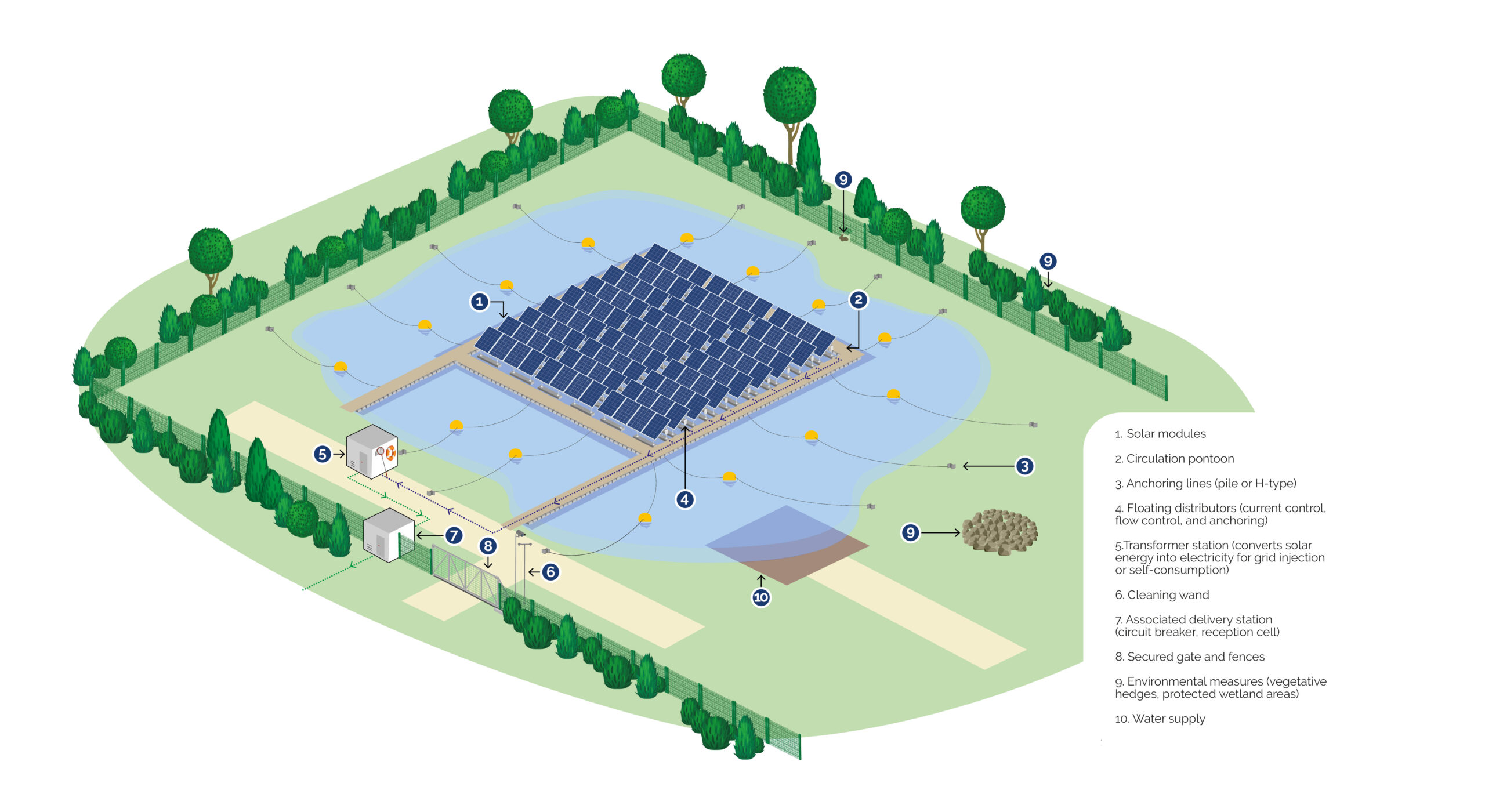
Urbasolar offers the most technically suitable solution for the configuration of the water body:
- The panels are mounted on floats (anchored either to the banks or with dead weights at the bottom of the lake) and arranged in a way that optimizes access to the plant throughout its operational life.
- The cables are inserted into conduits that run underwater, then connected to the transformation and delivery stations located on the shores.
- Grid connection is carried out in the same way as for a conventional power plant.
Our technical and environmental expertise
Our technical and environmental expertiseWe have developed real expertise in the design, development, construction, and operation of ground mounted and floating solar power plants.
Thanks to our in-house design office and multidisciplinary field teams, we offer for each project a solar power plant tailored to the nature of the land or water body, in line with your needs. Composed of engineers with complementary profiles (structural engineers, systems engineers, R&D, etc.), our design office allows us to utilize all technologies suited to your land:
- Fixed structures,
- Structures with trackers,
- Concentrated panels,
- Double-sided panels,
- Screw or molded pile anchoring,
- Beam anchoring,
- Floating anchoring.
Our development project managers oversee technical and feasibility studies in the field. These studies aim to consider all environmental and administrative constraints in the project’s development:
- Environmental impact study,
- Geotechnical study,
- Hydrological study.
As proof of our expertise and the quality of our monitoring, we have developed a partnership with CNRS on three floating power plants in Haute-Garonne. The SOLAKE project studies the effects of floating photovoltaic plants on aquatic biodiversity and ecosystem functioning with specific measurements.
Thanks to an internal team of construction managers, we can closely monitor all stages of the work until the solar power plant is commissioned. Similarly, our team of operation and maintenance engineers ensures the proper functioning of the ground-mounted or floating photovoltaic plant throughout its lifespan.
We handle all stages of the project, from administrative procedures (analysis, diagnosis, authorizations, etc.), design, construction, operation, and maintenance, to the dismantling and recycling of panels by the SOREN eco-organization, of which we are a founding member.
What are the advantages of a ground-mounted solar power plant?
Spanning a large area, this technology allows for significant solar energy production, equivalent to the annual electricity consumption of several hundred people.
The ground-mounted solar power plants we develop at Urbasolar allow you to:
VALUE
your unused spaces by transforming them into a source of electricity production and generating additional income;
OPTIMIZE
the maintenance of your land through eco-responsible management of all our sites (eco-grazing, late mowing, etc.);
DEVELOP
your site while respecting the environment;
INVEST
develop your site through economic benefits (collected taxes, citizen investment…);
PARTICIPATE
in the development of renewable energies and reduce your carbon footprint.
They trust us
We delivered a decontaminated site to Urbasolar, which took over with earthworks, clearing, and, of course, the construction of the photovoltaic plant. Honestly, with Urbasolar, it went very well. Urbasolar, from start to finish, at all stages of the exchanges, it’s quality professionalism. They are very thorough in their approach; it’s serious and friendly. We must continue the development of renewable energies, and there is enough technical progress to solve the problems of production intermittency.
Alain Legal
Mayor of Faux
References
Capacity:
5MWp
The floating solar power plant in Peyssies is a large-scale project combining environmental challenges and technological innovation.
Annual production of 6.2 GWh, equivalent to the consumption of 2,900 people
Capacity:
5MWp
The solar power plant located in Mésanger has been adapted to the site’s layout for optimal energy production.
Annual production: 5.4 GWh, equivalent to the electricity consumption of 2,500 people.
Capacity:
5MWp
The ground-mounted and floating solar power plant located in Noyant combines dual technology to rehabilitate a former industrial site.
Annual production: 5.7 GWh, equivalent to the electricity consumption of 2,650 people.
Ground-mounted photovoltaic plant on a former military site in Vaas (1min32)
Our other
solutions
As a true expert in photovoltaic technology, we are able to provide the solution that matches your site and your expectations.
Across the territory, our teams support you in carrying out your solar projects.
FAQ
Qui peut s’engager dans un projet agrivoltaïque ?
Tous les propriétaires et exploitants agricoles. Les agriculteurs et exploitants de terres cultivées, les éleveurs disposant de surfaces de pâturage, enfin les producteurs viticoles, maraîchers et arboriculteurs dont les parcelles et/ou les cultures sont adaptées à la réalisation d’un projet solaire.
Quels terrains sont éligibles à l'agrivoltaïsme ?
Un projet agrivoltaïque doit s’adapter à l’activité agricole. Plusieurs prérequis sont donc indispensables parmi lesquels nous pouvons citer le maintien obligatoire d’une activité agricole, des cultures ou élevages compatibles avec l’installation, une réversibilité de de cette dernière et enfin une co-construction du projet avec l’agriculteur.
Quels types d’agriculture peuvent cohabiter avec le photovoltaïque ?
La technologie photovoltaïque peut cohabiter avec plusieurs formes d’agriculture, à condition que le projet soit pensé d’abord pour l’activité agricole. On peut ainsi retrouver les activités d’élevage et pâturage ovin et bovin, les grandes cultures (fourrage ou céréales), le maraichage (salades, courgette, choux, fraises, framboises, PAPAM, …) et enfin, l’arboriculture et la viticulture.
Existe-il des aides pour les projets agrivoltaïques ?
Il n’existe pas d’aides directes, en revanche dans le cas d’un projet agrivoltaïque, les aides de la Politique Agricole Commune (PAC) sont maintenues si l’activité agricole est réelle.
Est-ce que le projet agrivoltaïque s'adapte à mes pratiques agricoles ?
La clé du succès d’un projet agrivoltaïque réside généralement dans une collaboration étroite entre les agriculteurs et les développeurs énergétiques, afin de concilier la production agricole et la génération d’énergie renouvelable. Le projet solaire doit répondre aux contraintes, besoins et pratiques de l’agriculteur et non l’inverse.