
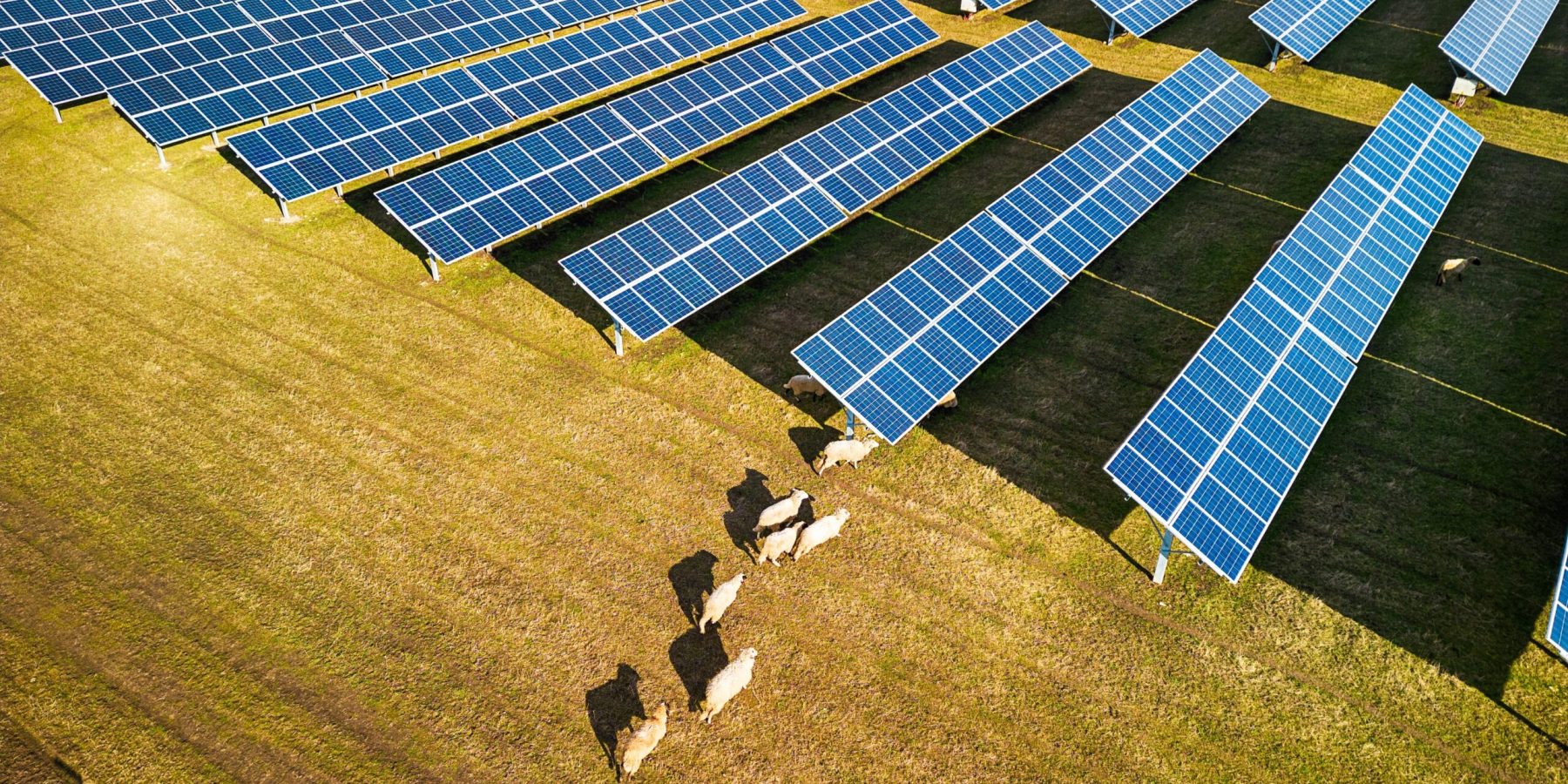
At Urbasolar, innovation goes beyond solar energy production. Through its recent research and studies, Urbasolar is reaffirming its commitment to animal welfare by incorporating practical solutions into its agrivoltaic projects to ensure the health and comfort of animals.
A Sustainable Response to Agricultural Challenges
Faced with climate change and growing economic pressures, agriculture is constantly evolving. Agrivoltaics—which combines agricultural production with green energy generation—represents a strategic lever in addressing these agricultural challenges.
At Urbasolar, this approach goes further: each project is designed with the specific needs of farmers and their animals in mind. Our ambition is clear: to foster a harmonious coexistence between agricultural ecosystems and photovoltaic installations. To achieve this, we conduct in-depth behavioral studies to adapt our structures to on-the-ground realities and the rhythms of the herds.
Equipment Designed for Animal Comfort
Ensuring optimal livestock conditions requires a structured approach and appropriate facilities. That is why we have compiled a list of essential equipment to be systematically included in our AgriPV facilities. Each project includes:
- Mobile and fixed fencing tailored to the type of livestock
- Watering troughs
- Scratching posts for cattle
- A restraint area
- Additional specific equipment based on the farmer’s needs.
The photovoltaic structures themselves are designed with agricultural operations in mind: panel height, spacing between rows, creation of internal pathways… everything is studied and validated in consultation with the farmer to ensure a smooth working environment that respects animal welfare.
Pilot Projects to Take Things Further
In the Gard and Haute-Saône departments, we are developing so-called experimental facilities dedicated to sheep and cattle farming. These pilot sites, equipped with various photovoltaic systems, will undergo rigorous agronomic monitoring for at least three years. The goal: to analyze the impact of these installations on animal welfare, as well as on the quality and quantity of forage resources, in conjunction with collected climate data. This data, representing real-world field experience, will help enrich and optimize our AgriPV offering.
Observe, measure, understand
Innovation also relies on technology. Within our agricultural R&D team, Noëllie Gelin, an agrivoltaics engineer, is deploying several sensor systems to better understand how animals use photovoltaic structures. Some ewes have been fitted with GPS collars for precise location tracking, while others have light meters attached to their harnesses to track their relative position in relation to the panels. These trials aim to validate a robust method for measuring animal positions in relation to local environmental conditions.
At the same time, the ethology research firm Bankiva will conduct a detailed analysis of the behavior of sheep and cows at these pilot solar power plants. Beyond their movement patterns, the entire animal life cycle will be observed to ensure our projects align with real-world needs on the ground.
We believe that the future of energy lies in an approach that respects the earth, people, and animals alike. Agrivoltaics is more than just a technology; it is a sustainable vision for the agriculture of tomorrow.