
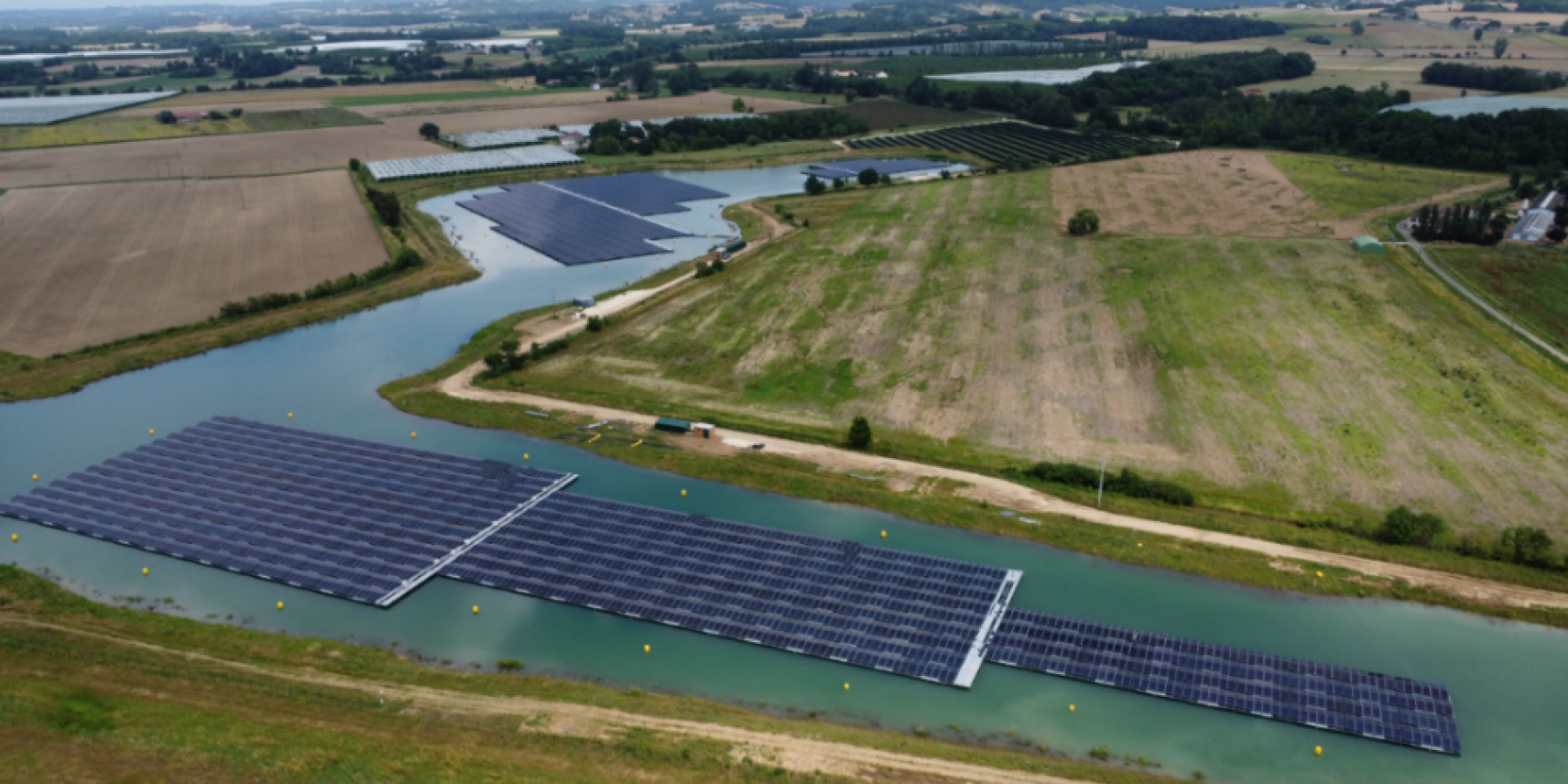
Commissioned at the end of July, the Aiguillon ground-mounted and floating power plant is located on the site of a former open‑pit sand and gravel quarry. It comprises a 7.1 MWp ground-mounted section and a 6.2 MWp floating section, for a total installed capacity of 13.3 MWp.
With an annual output of 12,250 MWh, this hybrid plant will produce the equivalent of the electricity consumption of 5,681 people, representing 30% of the Confluent et des Coteaux de Prayssas inter‑municipal community.
Over nearly 20 years, we have developed proven expertise in the construction of solar facilities. The Aiguillon plant adds to our portfolio with the distinctive feature of combining ground-mounted and floating technologies.
It is on the floating section that we implemented a foundation solution using steel H‑piles. Whereas floating plants are usually secured to the banks using deadweight anchors, the Aiguillon installation is distinctive in that it is connected to land by means of these H‑shaped steel beams, each 6 metres long and driven vertically into the ground.
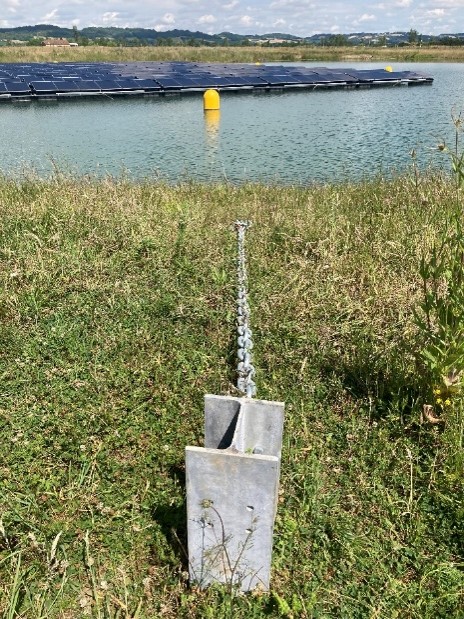 This is the first time that the Urbasolar Group has deployed this solution on one of its floating construction sites.
This pile‑based fastening system not only saved time but is also more robust, resulting in fewer anchoring points in the ground. As it does not require the use of concrete—whose production is highly energy‑intensive—it also reduces the project’s environmental footprint.
Driven in around the perimeter of the water body, these foundations therefore help preserve the often unstable banks.
It is an effective and efficient solution to ensure the stability of the installation on the water and to withstand the associated lateral loads.
In terms of maintenance, monitoring is also made easier since the anchor points are visible. This is a foundation system that the Group is keen to deploy on other structures, such as solar carports, in order to limit the use of concrete—even on already developed sites.
Credit photo Urbasolar