
Home / Our solutions / Photovoltaic Parking Canopies
Photovoltaic Parking Canopies
How do photovoltaic canopies work?
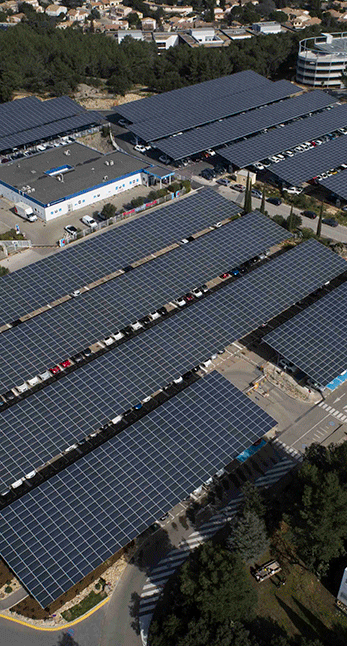
Photovoltaic canopies are structures equipped with solar panels, installed in parking or storage areas, to protect light vehicles, heavy trucks, or goods while generating electricity. They allow large artificial surfaces to be repurposed into renewable energy production sources.
Our technical expertise on photovoltaic canopies
With nearly 100 solar canopy projects completed across France, we have acquired solid expertise in this technology. We offer tailor-made solutions perfectly adapted to your needs and the specific constraints of your site and the items to be protected: cars, heavy trucks, or other goods!
Thanks to our specialized teams and in-house design office, we have developed various technologies for an optimal offer. We can thus propose the most suitable structure for your site: single-pole canopies (linked or not), double-pole canopies, or shelters for your vehicles and goods.
From the design phase, we place co-activity at the heart of the project, ensuring that your operations continue smoothly during the construction phase and throughout the operation of the solar plant. We ensure that your site is enhanced by this local source of green energy production.
Moreover, we pay particular attention to the landscape integration of the canopies and the comfort of your users and/or customers.
Finally, we support your decarbonization efforts by preparing sites to comply with the Mobility Orientation Law (LOM) through the installation of electric vehicle charging stations.
What are the benefits of solar parking canopies?
Installing photovoltaic canopies allows for multiple enhancements to your site.
Indeed, you significantly improve the comfort of your users and/or customers by providing additional services in your parking lot, such as protection against weather conditions (extreme heat or heavy rain), nighttime lighting for better site security, and rainwater management through the installation of gutters.
Thanks to the canopies, your vehicles and/or stored products are less exposed to risks, which may allow you to negotiate a reduction in your insurance costs.You can also anticipate the development of electric mobility by installing charging stations directly powered by green energy and protected by solar panels.
You comply with the Renewable Energy Production Acceleration Law of March 2023, which requires existing parking lots over 1,500 m² and new parking lots over 500 m² to install photovoltaic canopies on 50% of their surface area.
By producing decarbonized energy on your site, you contribute to national renewable energy development goals and greenhouse gas reduction. You thus become an active participant in the energy transition, a commitment you can highlight both in your CSR policy and to your customers and users.
Your site gains value from a real estate perspective and in terms of customer experience.
They trust us
We consulted several companies specializing in photovoltaics to better understand the economic models, with the goal of integrating parking canopy installation into the CHU’s establishment project. This operation allows us to rethink parking organization in terms of quality, creating additional spaces, developing alternatives to cars, and amplifying carpooling, aiming to reduce vehicle flow at the CHU. A call for tenders was launched in early 2017, and Urbasolar was selected due to the relevance and professionalism of its offer, as well as a more appealing aesthetic proposal with a metal and wood solution.
Marie-Laure PIQUÉ & Christophe CHAUSSENDE
Engineer - Director of Procurement/Logistics - Material Resources Division - CHU de Nîmes
References
Capacity:
36 MWp
Disneyland Paris
Disneyland Paris has chosen to equip its visitor parking lot with photovoltaic canopies, covering 11,200 spaces, making it one of the largest plants of its kind in Europe.
Annual production of 36 GWh, equivalent to the consumption of 17,400 people.
Capacity:
1 MWp
NTN Europe
The NTN Europe industrial group has equipped its parking lot with photovoltaic shading systems to produce low-carbon energy locally and provide greater comfort for customers and employees.
Annual production 1.1 MWh, equivalent to the electricity consumption of 500 people
Capacity:
9 MWp
STVA
A 36-hectare logistics platform, the installation of solar-powered shading systems protects the 15,000 vehicles stored there.
Annual production 13 GWh, equivalent to the electricity consumption of 6,000 people
Parking canopy at the MCT logistics platform in Hambach on video (1min33)
Our other
solutions
As a true expert in photovoltaic technology, we are able to provide the solution that matches your site and your expectations.
Across the territory, our teams support you in carrying out your solar projects.
FAQ
What are solar car park canopies?
A solar canopy is a structure installed over a parking area and equipped with photovoltaic panels. It generates electricity while protecting vehicles from adverse weather conditions. It may also include options such as lighting and electric vehicle charging stations.
Why install photovoltaic car park canopies?
Solar canopies generate green electricity while making use of already developed land. They improve user comfort by providing shade and weather protection and support companies’ CSR commitments.
Are photovoltaic car park canopies mandatory?
In France, regulations are evolving. The 2023 APER Law progressively requires outdoor parking areas larger than 1,500 m² to be equipped with renewable energy production systems, such as photovoltaic canopies.
Can my business continue operating during the construction of car park canopies?
Yes. In most cases, business operations can continue throughout the construction phase. Work is organized in line with site activities to minimize disruption and ensure safe management of simultaneous operations.